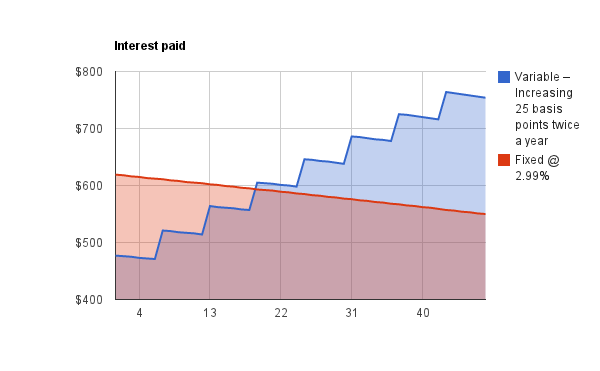
In a fixed-rate home mortgage, the rates of interest is set when you secure the loan and will not change over the life of the mortgage. Fixed-rate home loans provide stability in your home loan payments. In a variable-rate mortgage, the rates of interest you pay is connected to an index and a margin.
The index is a measure of worldwide rate of interest. The most frequently used are the one-year-constant-maturity Treasury securities, the Cost of Funds Index (COFI), and the London Interbank Deal Rate (LIBOR). These indexes make up the variable element of your ARM, and can increase or reduce depending upon factors such as how the economy is doing, and whether the Federal Reserve is increasing or decreasing rates.
After your preliminary set rate duration ends, the lending institution will take the existing index and the margin to determine your brand-new rates of interest. The quantity will alter based upon the adjustment period you chose with your adjustable rate. with a 5/1 ARM, for instance, the 5 represents the number of years your initial rate is repaired and won't change, while the 1 represents how often your rate can adjust after the fixed duration is over so every year after the 5th year, your rate can change based on what the index rate is plus the margin.
That can imply substantially lower payments in the early years of your loan. Nevertheless, keep in mind that your situation might change before the rate modification. If rate of interest rise, the value of your residential or commercial property falls or your financial condition modifications, you may not have the ability to offer the house, and you might have problem making payments based upon a higher rates of interest.
While the 30-year loan is often picked because it offers the least expensive regular monthly payment, there are terms varying from 10 years to even 40 years. Rates on 30-year home loans are greater than shorter term loans like 15-year loans. Over the life of a much shorter term loan like a 15-year or 10-year loan, you'll pay significantly less interest.
You'll likewise require to choose whether you want a government-backed or standard loan. These loans are insured by the federal government. FHA loans are assisted in by the Department of Housing and Urban Development (HUD). They're designed to help novice property buyers and individuals with low incomes or little savings manage a home.
An Unbiased View of How Canadian Mortgages Work
The disadvantage of FHA loans is that they require an upfront home mortgage insurance charge and monthly home mortgage insurance coverage payments for all purchasers, no matter your deposit. And, unlike standard loans, the home loan insurance coverage can not be canceled, unless you made at least a 10% deposit when you took out the original FHA mortgage.
HUD has a searchable database where you can find loan providers in your location that use FHA loans. The U.S. Department of Veterans Affairs uses a home loan program for military service members and their families. The advantage of VA loans is that they might not need a deposit or home mortgage insurance coverage.
The United States Department of Agriculture (USDA) provides a loan program for homebuyers in backwoods who meet certain earnings requirements. Their property eligibility map can provide you a general concept of certified places - how do reverse mortgages work. USDA loans do not need a deposit or ongoing home mortgage insurance, but debtors should pay an in advance fee, which currently stands at 1% of the purchase cost; that cost can be financed with the home loan.
A standard home mortgage is a house loan that isn't guaranteed or insured by the federal government and adheres to the loan limitations set forth by Fannie Mae and Freddie Mac. For borrowers with higher credit history and stable earnings, standard loans often lead to the least expensive monthly payments. Generally, traditional loans have actually needed bigger down payments than the majority of federally backed loans, however the Fannie Mae HomeReady and Freddie Mac HomePossible loan programs now provide debtors a 3% down alternative which is lower than the 3.5% minimum required espn magazine subscription cancellation by FHA loans.
Fannie Mae and Freddie Mac are federal government sponsored business (GSEs) that purchase and sell mortgage-backed securities. Conforming loans meet GSE underwriting standards and fall within their maximum loan limits. For a single-family home, the loan limitation is currently $484,350 for most homes in the contiguous states, the District of Columbia and Puerto Rico, and $726,525 for homes in higher cost locations, like Alaska, Hawaii and numerous U.S.
You can look up your county's limits here. Jumbo loans might also be referred to as nonconforming loans. Put simply, jumbo loans surpass the loan limitations established by Fannie Mae and Freddie Mac. Due to their size, jumbo loans timeshare wiki represent a higher risk for the lending institution, so customers should normally have strong credit rating and make bigger deposits - reverse mortgages how they work.
How Do Mortgages Work When You Move - Truths
Most lenders require a minimum FICO score of 620 for a fixed-rate mortgage or 640 for a variable-rate mortgage. For government-backed loans, the requirements are a little lower normally 580, however as low as 500 in many cases. Your debt-to-income ratio (DTI) is the total of your monthly debt payments divided by your gross regular monthly income.
To receive a conventional loan, lending institutions usually need DTI of 45%. Nevertheless, with a high credit report, and at least two months of reserves, the lending institution might enable a DTI of as much as 50%. Reserves are highly liquid assets that are available to you after your mortgage closes, such as: Cash in checking and savings accounts Investments in stocks, bonds, mutual funds, CDs, money market funds and trust accounts Vested pension assets The cash worth of life insurance coverage policies Basically, reserves are properties that you could tap to make your home mortgage payments if you were to strike a rough financial spot.
It might require copies of paystubs, W-2s, income tax returns and other paperwork to make an evaluation. Often altering jobs will not necessarily disqualify you from a mortgage if you can show that you've earned a constant and foreseeable earnings. Depending upon your lender's guidelines and other credentials aspects, you may be able to receive a conventional loan with a down payment as low as 3%.
PMI is an insurance policy created to secure the loan provider if you stop paying on your loan. PMI might be paid in monthly installments in addition to your regular home loan payment, in an in advance premium paid at closing or as a combination of the 2. Government-backed loans have various down payment requirements.
Given that mortgages are long-term dedications, it's necessary to be informed about the benefits and drawbacks of having a home mortgage so you can choose whether having one is ideal for you. A home mortgage permits you to buy a home without paying the complete purchase price in cash. Without a mortgage, few people would have the ability to pay for to purchase a house.
Lots of house owners get house equity loans or lines of credit to pay for house enhancements, medical bills or college tuition. Having a mortgage in excellent standing on your credit report enhances your credit report. That credit rating figures out the rates of interest you are used on other credit products, such as vehicle loan and charge card.